Practical cryptocurrency guides
Polynomial is a Superchain perps venue built around cross-margin execution
Bottom line: Decentralized perpetuals exchange powered by its own Ethereum rollup, built for trading crypto perps with fast, composable execution.
Polynomial is a decentralized perpetuals exchange on its own Ethereum Layer 2, with a trading workflow centered on one margin account, multi-collateral deposits, and execution designed for fast onchain crypto perps. The practical angle is simple: a trader uses ETH, stablecoins, and supported assets as margin, opens long or short perpetual positions, and manages risk across markets without splitting collateral into isolated accounts.
This makes the exchange most relevant to traders who already understand perpetual futures and want a DeFi venue that keeps execution, margin, staking, and bridging close to the same rollup environment. The product is built for active positioning rather than passive spot swaps, so the useful questions are about collateral movement, liquidation logic, order quality, and how the rollup setup affects the trading path.
The cross-margin account changes how positions share collateral
On Polynomial, cross-margin means open positions draw against a shared account balance instead of requiring separate collateral silos for each market. A profitable position strengthens the overall account, while a losing position consumes the same pool of available margin. That arrangement improves capital efficiency for traders running multiple crypto perps, because idle collateral does not sit trapped behind one trade.
The same design also raises the importance of total account exposure. If several positions lean in the same direction, a sharp move in Bitcoin, ETH, or another major asset affects the margin account as a whole. The protocol's interface matters here because the trader needs clean visibility into account equity, unrealized profit and loss, margin usage, and liquidation distance before adding another leg.
Multi-collateral margin keeps the trade path shorter
Multi-collateral support lets users bring ETH, stablecoins, and other supported assets directly into the margin system. That reduces extra conversions before trading and makes it easier to maintain an account in the assets a trader already holds. A stablecoin-heavy account gives clearer dollar-based accounting, while ETH collateral keeps exposure closer to the asset many DeFi traders use for bridging and gas.
Because collateral values move, the margin balance reflects both position performance and collateral price changes. A trader using volatile collateral accepts that the backing asset itself affects account health. This is especially important when the open position and the collateral asset are correlated, since both sides of the account move during market stress.
Pool-based AMM execution starts markets with usable liquidity
Polynomial starts markets with a pool-based automated market maker, which helps newer or thinner markets support trades before deep orderbook liquidity develops. The model is built to reduce price impact when entering or exiting positions, especially where a pure orderbook would feel sparse. For a perps venue, that early liquidity layer matters because traders judge the experience by fill quality as much as by listed markets.
As markets mature, execution is designed to upgrade toward an orderbook. That path gives the exchange a way to support both early market bootstrapping and tighter, more precise execution once enough demand exists. It is a different emphasis from venues that rely only on market makers from the start or only on AMM curves for the entire life of a market.
Oracle-based liquidations aim at wick-resistant risk control
Liquidation quality is one of the defining details for a perpetuals exchange. Polynomial uses oracle-based liquidation logic, which means account health is judged against external price feeds rather than a single local trade print. The goal is to reduce forced exits caused by brief exchange-specific wicks or manipulation around thin order flow.
That mechanism does not remove liquidation risk. High leverage still compresses the distance between the entry price and the forced-exit zone. The useful distinction is that the liquidation trigger follows an oracle view of market price, giving the risk engine a reference point that is broader than the last fill inside one venue.
A first trade starts with bridge, collateral, market, and size
A sensible workflow begins by moving assets to the rollup through the bridge, then choosing which collateral to hold in the margin account. Once the account is funded, the trader selects a market, decides between long and short exposure, and sets position size with margin usage in view. Polynomial is built around fast trading, so the interface is meant to keep those steps close together.
- Bridge supported assets to the exchange's Ethereum Layer 2.
- Deposit eligible collateral into the shared margin account.
- Choose a perpetual market and direction.
- Review margin usage, liquidation distance, and expected price impact.
- Open the trade and monitor funding, profit and loss, and collateral value.
The important habit is to treat order entry and account monitoring as one workflow. Perps are continuous instruments, so the position remains exposed after the transaction confirms. Account health, collateral volatility, and market movement keep changing until the position is reduced or closed.

Superchain placement gives builders and traders the same execution layer
The exchange runs on its own Ethereum Layer 2 and sits within the Superchain environment. That structure gives it a dedicated execution layer for perps activity while staying aligned with Ethereum-based assets, wallets, and DeFi infrastructure. Traders get a purpose-built venue; builders get a composable base where markets, integrations, and adjacent tools reference the same trading system.
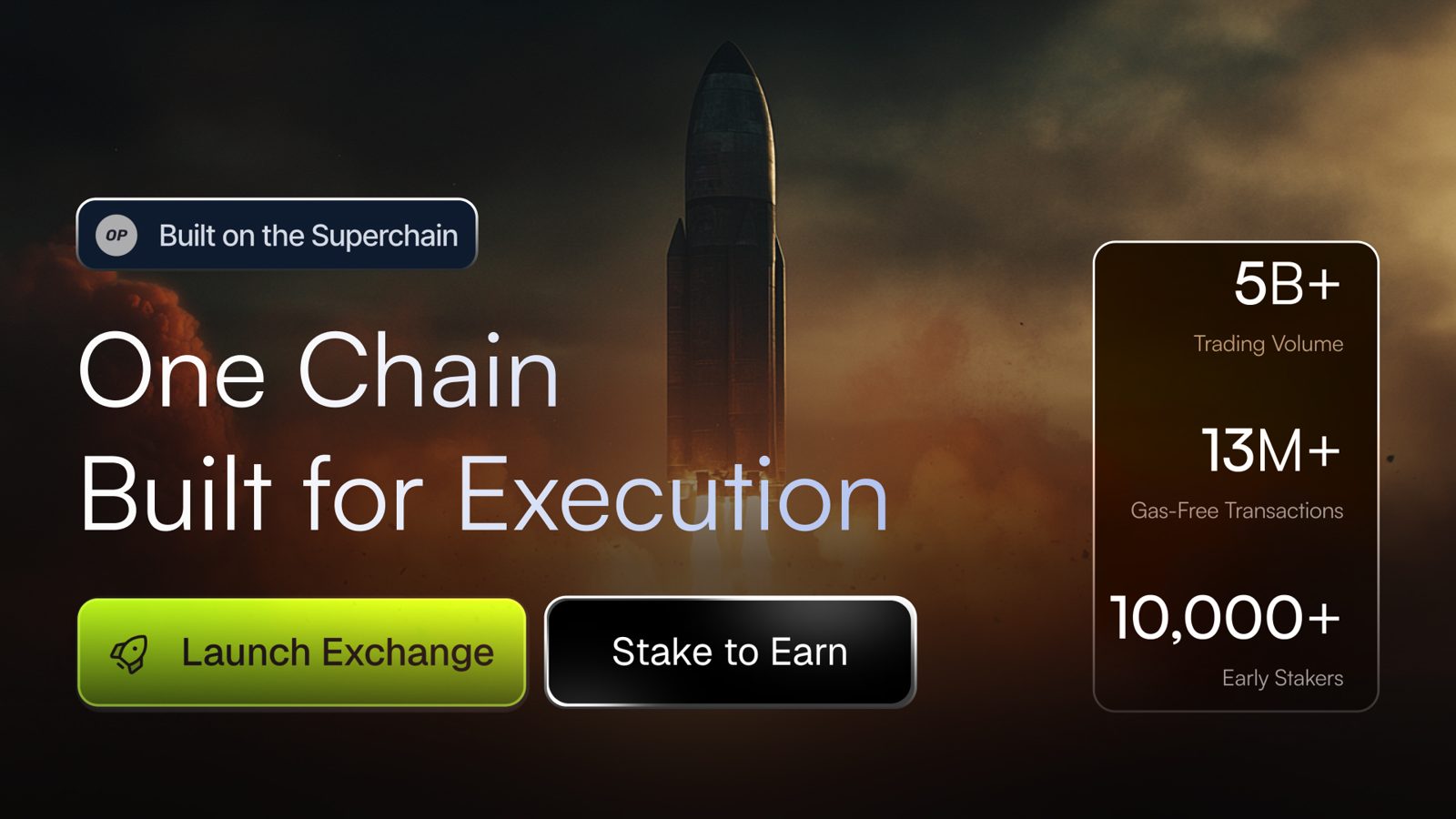
Notably, Polynomial's site frames the chain as built for execution, staking, and open building. That matters because a perps exchange becomes more useful when liquidity, interfaces, analytics, and account tools grow around it. A rollup dedicated to the product gives the ecosystem room to tune around trading behavior rather than competing with unrelated application traffic.
Staking connects user participation to the exchange economy
Staking is part of the project's system design, with the official messaging emphasizing a rollup where staking powers the network. For users, this creates a second activity next to trading: committing assets to participate in the exchange economy rather than only opening leveraged positions. The exact return experience belongs to the live staking interface, but the role is clear: capital participation supports the system around the perps venue.
This also separates two different user intents. A trader focuses on margin, fills, and risk. A staker focuses on lockup terms, reward mechanics, and exposure to the system's growth. Some users do both, but the risk profile differs, so the actions should be evaluated separately.

Where this fits beside GMX, dYdX, and Hyperliquid
Crypto perps traders already compare venues by liquidity depth, supported collateral, fee clarity, wallet experience, and liquidation behavior. GMX is known for DeFi perps built around pooled liquidity, dYdX is associated with orderbook-style derivatives infrastructure, and Hyperliquid is recognized for a high-speed trading experience with deep perps focus. Polynomial positions itself around a dedicated Ethereum rollup, cross-margin, multi-collateral support, and an execution model that evolves from AMM liquidity toward orderbook precision.
The choice between venues comes down to the trade a user is actually placing. A small directional trade values simplicity and predictable margin accounting. A larger multi-market strategy cares more about cross-margin efficiency, slippage, liquidation rules, and how quickly collateral reaches the trading account. That is where this exchange's design details become more meaningful than a broad category label like decentralized perps.
The main tradeoff is leverage discipline on shared margin
Cross-margin is powerful because collateral works across the whole account, but it also links positions together. A mistake in one market affects the buffer available to every other open trade. This is the central risk to understand before increasing size: shared margin improves flexibility while concentrating account-level consequences.
For active users, the best experience comes from sizing positions around the full account rather than one chart. Polynomial gives the infrastructure for fast perps trading on a dedicated rollup; the trader's job is to keep collateral quality, leverage, and liquidation distance aligned with the volatility of the markets being traded.
Quick answers about Polynomial
- Does cross-margin on Polynomial require separate accounts for each perps market?
- No. The cross-margin design uses one shared margin account across supported positions, so collateral is not split into isolated balances for every market. That improves capital efficiency when several positions are open, because available equity supports the account as a whole. It also means losses in one position reduce the buffer available to other positions in the same account.
- Which collateral assets make the most sense for Polynomial perps trading?
- The exchange supports multi-collateral margin, including ETH, stablecoins, and other eligible assets shown in the live interface. Stablecoins create simpler dollar-denominated accounting, while ETH keeps collateral aligned with common Ethereum DeFi flows. Volatile collateral changes value while positions are open, so account health depends on both trade performance and collateral price movement.
- Fees on Polynomial: what costs should a trader expect to review?
- A trader should review trading fees, funding payments, spread or price impact, and any bridge-related costs before opening a position. Perpetuals also involve ongoing funding dynamics between long and short exposure, so the cost of holding a trade changes over time. The exact numbers belong in the active exchange interface because market conditions and parameters change.
- Can I use Polynomial from a normal Ethereum wallet?
- Yes, the workflow is designed around self-custody wallets used across Ethereum and Layer 2 networks. A user connects a wallet, bridges supported assets to the exchange's rollup, deposits collateral, and trades from the connected account. The key requirement is having the right network and supported assets available for the trading and margin steps.
- Orderbook or AMM: which execution style does Polynomial use first?
- Markets start with a pool-based AMM designed to support usable liquidity, especially when a market is new or thinner. As market activity grows, execution is designed to move toward an orderbook model that supports tighter spreads and more precise fills. That staged approach gives new markets a liquidity base before they develop deeper trading activity.
- Why does oracle-based liquidation matter for perps traders?
- Oracle-based liquidation uses external price feeds as the reference for account health instead of relying only on a local trade print. That matters because brief wicks or thin local trades create poor liquidation signals on some venues. An oracle reference gives the risk engine a broader market view, though high leverage still leaves little room for adverse price movement.